Platform Engineering as the Foundation for Products in the Age of Autonomous Agents
Chapters
AI is enabling product teams to now generate prototypes, APIs, and integration code much faster than before. Work that used to take a two-week sprint can sometimes be scaffolded in an afternoon. Ideas are fast, and local development has never felt more fluid.
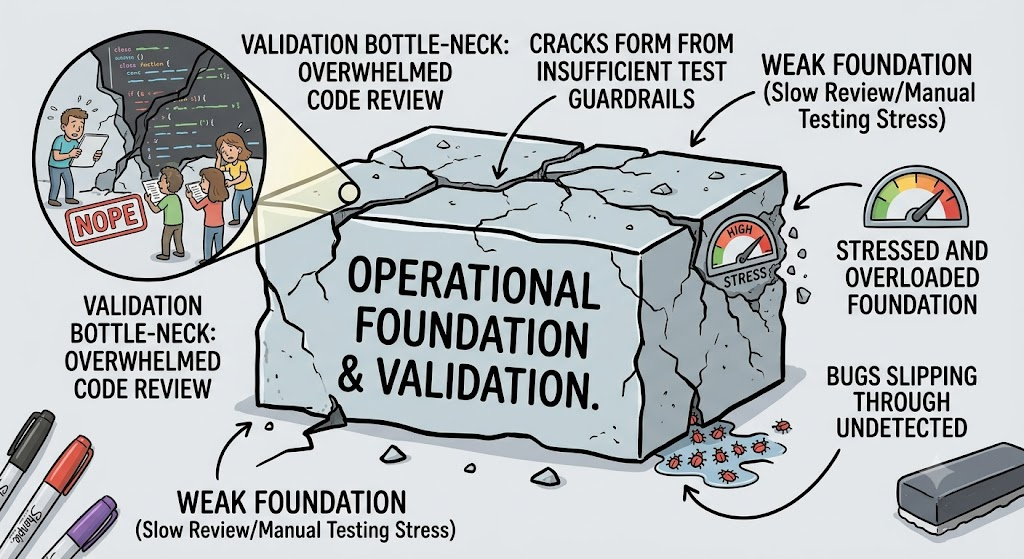
While development velocity accelerates, it is immediately followed by code reviews, change detection, deployment, security reviews, change control, and ongoing maintenance. We are entering an era where we frequently pay the price for that initial upfront speed. AI has made drawing conclusions and writing boilerplate dramatically faster, but product engineering is still capped by the same brutal limitations of the production environment. Seamless delivery, review churn, and operational uniformity are at greater risk than ever.
Product vs Platform Engineering - Different Pressures, Different Optimizations
As AI agents increasingly assist with execution, the primary differentiator between product and platform engineering is on areas of ownership. Product teams own their underlying business domain, platform teams construct frameworks for cross-cutting backend features and implement operational guardrails that enable product teams to scale efficiently.
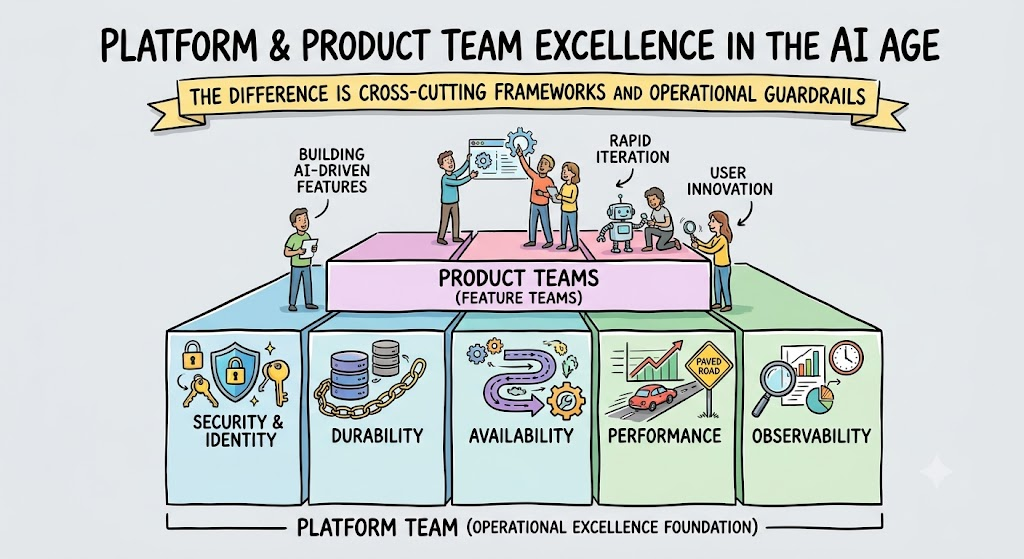
That is why product and platform engineering are optimized for fundamentally different problems. Product teams own direct user value and experiment velocity. They work with large local variation because their primary goal is finding what works for the business and technical realm.
Platform teams, on the other hand, own the shared primitives, architectural consistency, and operating confidence. Their blast radius is global. They need stable contracts because dozens of other teams depend on them.
That is why I think Platform engineering view and responsibilities are shifting rapidly. We are no longer just a rebranding of the “DevOps” or infrastructure team fixing low-level server issues. It is the team that builds solid foundations — authentication layers, API gateways, traffic management, and fleet support. It is AI guardrails, Operational Excellence, and Low Level Primitives ownership as a service.
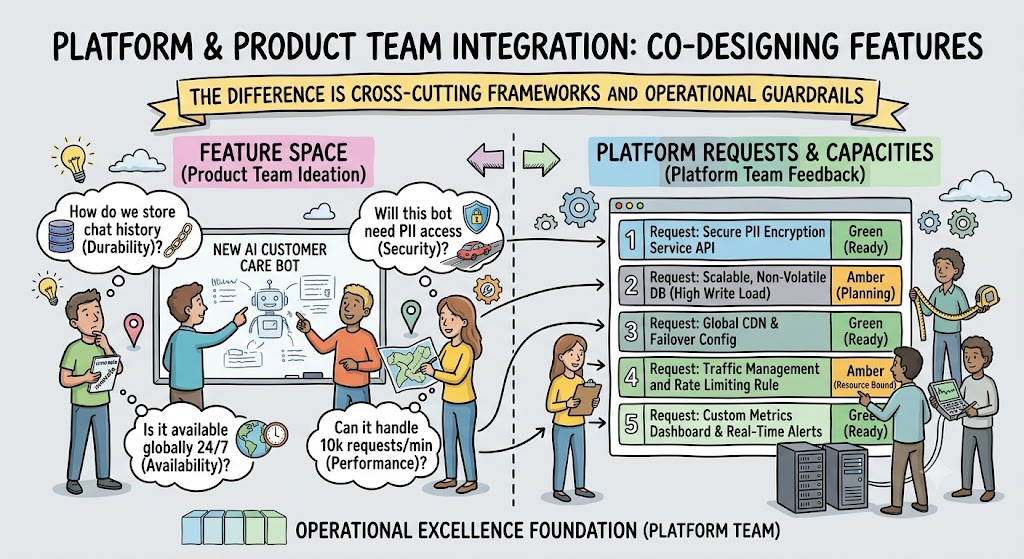
Product teams optimize for user outcomes and iteration speed. Platform teams optimize for fleet management and staying ahead of the future needs. Both teams are essential for the organization to succeed, but they have different optimization goals. What glues all together? I think it is an “operational excellence”. Operational excellence in that context is the practical mechanism that keeps those two goals compatible, letting product engineering teams work on the shoulders of giants (platform engineering) without sacrificing velocity.
When researching topic I found that Team Topologies book which highlights that modern definition of platform teams. Platform teams function as internal products designed fundamentally to minimize cognitive load for product developers. Meanwhile, the Google SRE Book structures this more as a partnership around service ownership and quantifiable launch readiness. Today, those lessons are more urgent. If AI drastically accelerates delivery, the platform must be robust enough to absorb the accompanying reliability burden.
Operational Excellence as the Platform Contract
Operational excellence is where this distinction becomes tangible. It isn’t a checklist of paperwork; it is a set of functional feedback loops. Platform teams institutionalize these loops so product teams can consume and extend them without having to invent them from scratch.
We can frame this “Platform Engineering contract” across multiple pillars like:
Security and Identity: Enforcing secure defaults and automated identity management so product teams don’t hand-roll bespoke, vulnerable authentication for every new AI-driven feature.
Durability: Providing standardized data storage and state management primitives that protect data despite rapid, AI-assisted application changes.
Availability: Establishing standard rollout mechanisms and deployment pipelines that automatically enforce safety checks and prevent downtime.
Performance: Setting baseline efficiency standards and paved roads for traffic management that new code must meet before reaching production.
Observability: Defining standard telemetry expectations so that when a rapidly generated feature fails, the blast radius and root cause are immediately legible.
Platform Teams as AI Guardrail Providers
What are “AI guardrails” in a broader engineering organization? They are more than just prompt rules or LLM wrappers. Good platform engineering reduces the cognitive load of safe operation. Guardrails are not restrictions for their own sake, but paved roads that let product teams move fast safely.
In AI-enabled teams, platform engineering increasingly provides service templates, standard observability expectations, automated security defaults, and production feedback loops. These components act as the structural safety net for the organization.
What Good Looks Like
As the industry increasingly embraces AI, establishing well-defined operational patterns is the most critical action an organization can undertake. This dynamic between product and platform engineering ultimately balances on a constructive, healthy tension.
When product engineering asks, “Can we build this fast?” platform engineering must respond by asking, “Can every single team build this with the same speed and predictability?
To evaluate if your platform is prepared to absorb AI-accelerated delivery, consider this practical assessment checklist:
- Do your product teams inherently receive safe defaults across all areas of operational excellence?
- Are reliability expectations clearly visible and evaluated prior to each launch?
- Is rollout behavior thoroughly standardized?
- Does the platform effectively minimize operational variance between different teams?
Answering yes to these questions means you have established the required framework to survive and flourish in an era of rapid software deployment. If you are not there yet, our upcoming follow-up series will explore effective patterns to address these challenges at a structural level.